Selected work · 03

Proof of conceptOpen source · MITIoTidesAug 2026

Malayalam Phone Reception Agent

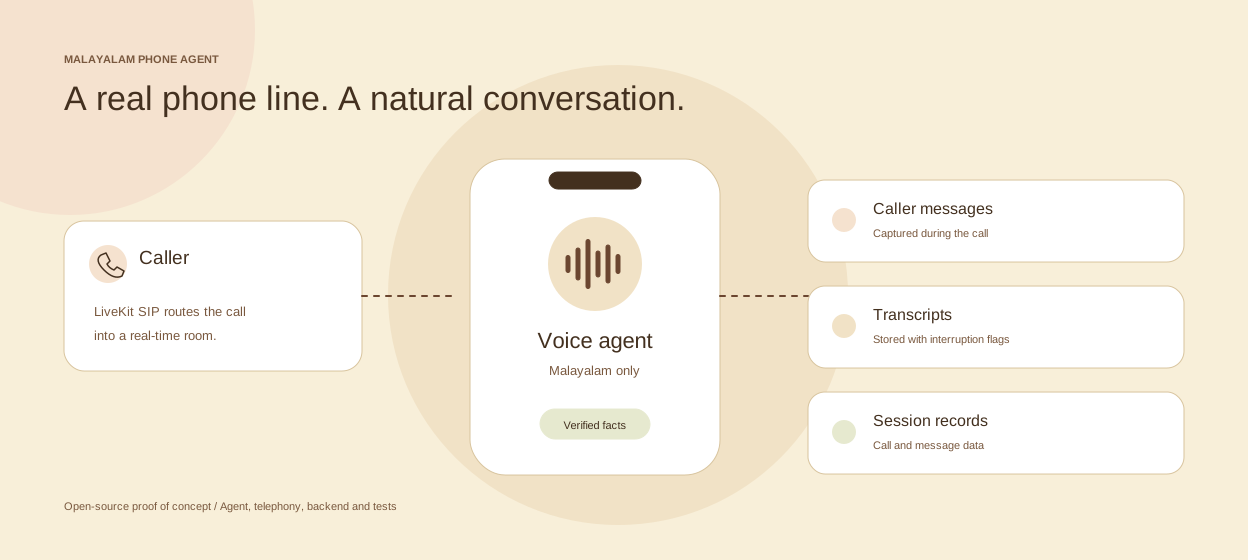
A phone receptionist reachable on a real number. It answers as the IoTides receptionist, speaks only Malayalam, answers questions from verified company facts, takes messages, and stores every call's transcript.

Python · LiveKit Agents · LiveKit SIP telephony · Gemini Live API · FastAPI · SQLAlchemy · PostgreSQL · pytest
Role
Developer, IoTides
Status
Proof of concept
Published
Aug 2026
Tests
23 pytest tests
An illustrated Malayalam phone agent with call routing, messages and transcripts.
A conversation on a real phone line. Conceptual illustration, not a product screenshot.

What it does

A caller dials a real phone number. LiveKit's SIP telephony routes the call into a room, where the agent answers. A single Gemini Live speech-to-speech model does the listening and speaking, so there's no separate speech-to-text → LLM → text-to-speech chain to stitch together.

  1. CallerDials the provisioned number
  2. LiveKit SIPDispatch rule creates a call room
  3. AgentGemini Live, Malayalam only
  4. FastAPIMessages mid-call, transcript at end
  5. PostgreSQLCalls, transcript turns, messages

Call path, from the repository's architecture diagram.

Source

The proof of concept was published as an MIT-licensed repository: the agent, telephony provisioning, backend and tests.

GitHub · MIT
github.com/s4b11/livekit-ivr
View repository

This page describes only what's in that repository. My other voice-agent work at IoTides is proprietary and isn't shown here.

What's implemented

  • Real telephony: a provisioning script rents a LiveKit phone number and creates the SIP dispatch rule; the agent runs containerised on LiveKit Cloud.
  • Agent tools: get_business_hours, take_message and end_call. The agent is grounded only in verified company facts.
  • Barge-in: callers can interrupt; their speech cancels the agent's audio.
  • Transcripts on both sides: input and output audio are transcribed and stored with per-turn interruption flags.
  • Backend: a FastAPI ingest API with async SQLAlchemy models for call sessions, transcript items and caller messages.

Tuned for phone audio

The turn-detection settings were chosen from real call logs:

SettingValueWhy
End-of-turn silence400 msReply quickly without cutting callers off
Speech sensitivityHigh (start and end)Catch interruptions on narrow phone audio
Prefix padding300 msKeep the start of each utterance
Model thinking budget0Removes multi-second variation in reply time

Testing

The repository README lists 23 pytest tests in three layers. I haven't re-run them for this page; they're the repository's own claims at publication.

  • Unit tests: session-report to transcript-payload conversion, with no services needed.
  • Integration tests: the FastAPI API and an end-to-end transcript flow against PostgreSQL.
  • Behaviour tests: the real agent run through the LiveKit Agents test framework, judged by an LLM.

Known limitations

  • It's a proof of concept, not a production deployment.
  • No transfer to a human. The agent can take a message or end the call, but it doesn't hand calls over.
  • Cloud transcript storage isn't wired up. Until the backend is hosted somewhere reachable, the cloud agent saves transcripts as JSON files inside its container.
  • One language, one persona. It speaks only Malayalam, by design.